On Michael Clune
Ping. Dip. Zzzz.

Michael Clune’s most recent indiscretion came out last year and has been thoroughly reviewed elsewhere. This will be merely a collection of my thoughts on it, not so much a traditional review. The book is not extremely plotty, nor is it extremely novelly, but if you’re one of those who needs story overview I won’t be doing that here. I can recommend the review at The Baffler and Xian’s good piece on it at the LRB for this purpose.
Below I will be taking up other matters of far more import than mere plot.
If you enjoy this, do read my most recent pieces on Maggie Nelson and debunked popular American health fantasies. I will have a short piece out at the Times Literary Supplement this week.
My Weep Ship: On Clune’s Pan
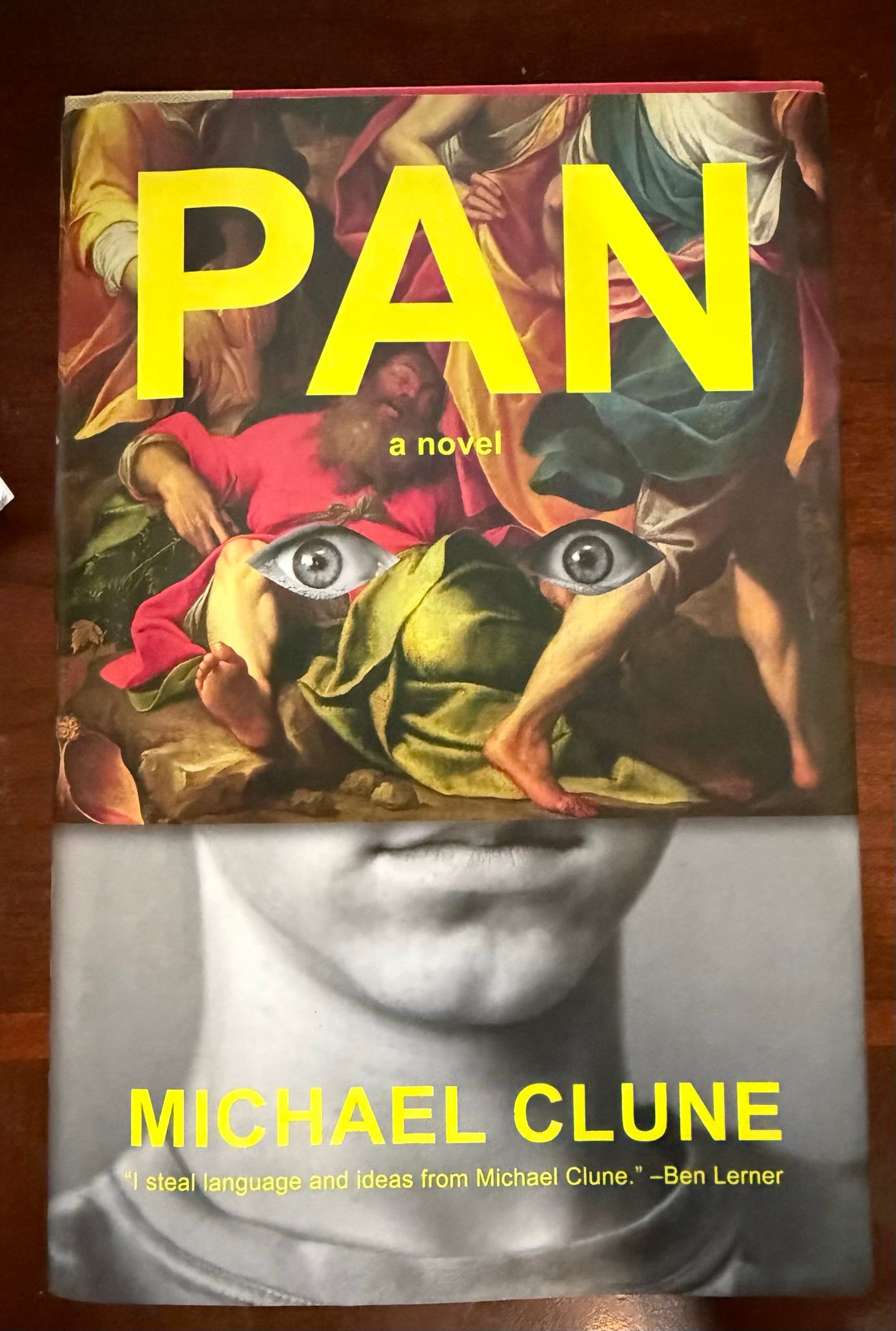
I can only think of Michael Clune’s Pan as a kind of failed comic novel. So many of the scenarios and lines slyly amuse, yet ache to be truly funny, such as:
… they found a four-year-old girl dead of old age. That was the coroner’s conclusion, after examining her organs.
No explanation is given for this coroner’s conclusion, nor for the dead girl herself. The line is not funny, merely gruesome as written, but it had great potential to be Mel Brooks-level funny. Instead, it leaves one irked and sad, a feeling of having witnessed a small, decrepit corpse having her organs fingered. Not a fetching image to start out with, and not one that is referred to again in the text.
And the opening lines of the book:
My mom kicked me out. My behavior was getting out of control.
Quirky, sullen, Salingeresque, a little dull but anyway we’re clearly the audience of an angsty teen, and therefore expecting some amusing hijinks to ensue.
But no hijinks ensue. It goes on in this callow, noncommittal mode for a few hundred pages, skating on the verge of comedy. Throughout the book, Clune can’t decide whether to be profound and philosophical or vaguely satirical. He winds up being neither.
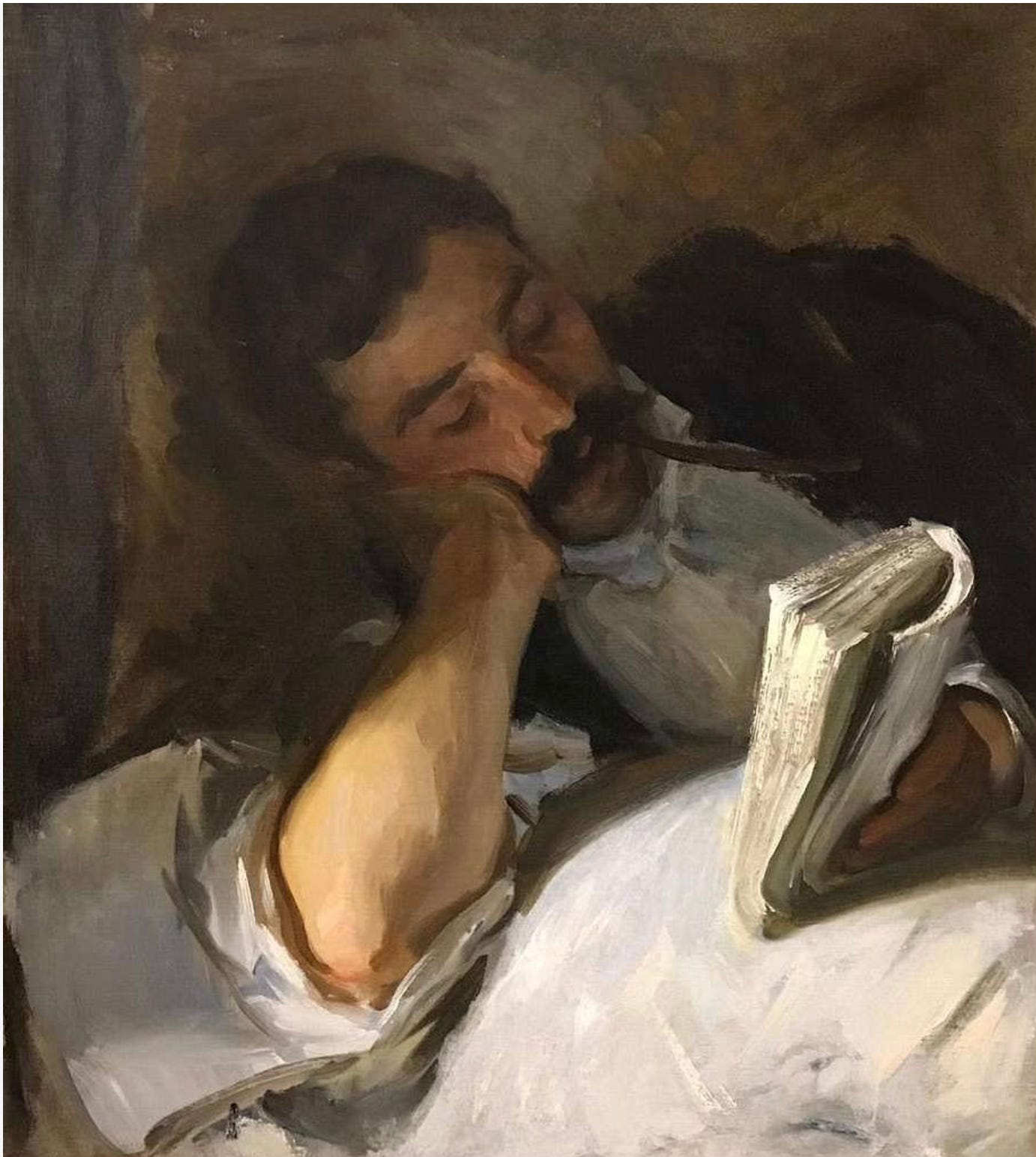
As a result, I found I had a very weak, expectant smile plastered on my aching face for the first half of the book, at which point my expression changed dramatically—the lips slunk decidedly grimaceward; dozing eyelids began to beat soft and slow, like the wings of a resting butterfly. My daybed called to me—reader, I put the book down and napped.
Not a comedy after all, then, but a YA-adjacent bildungsroman that squanders a lot of goodwill and peters out around page 200.
The writing itself is an issue. My issue, anyway. The very early and—I’m supposing—deliberate weaknesses in the writing, such as
No one’s face held any kind of future for any neighbor
The raw death of the endless future
The builders had wrought a few charms against total exposure to time.
fascinate at first, rather than repulse. They’re so inept as to suggest some kind of trick or artful agenda. No such luck. I’m not sure what these lines mean, but at least they’re accurately kid worthy. They’re meant to reflect, I guess, the simple, searching mind of intelligent Nick, our 15-year-old narrator. Yet here the mimetic fallacy intrudes on my thoughts, about which I will say only this: only very good writers can successfully write deliberately bad prose. The first paragraph in Martin Amis’s The Information contains the line “Swing low in your weep ship” which, in context, makes me laugh aloud every time I read it, and I’m not totally sure why. I suppose it’s because it’s a line of self-pitying writing that captures Richard Tull’s lugubrious mentality, his satirized, impotent struggle to write powerfully, meaningfully enough to destroy his frenemy with his literary genius. He fails at this and becomes merely a vengeful sad sack. He’s envious. And envy is funny.
Clune doesn’t have those kind of chops or that kind of distance from his characters. To be funny in fiction, the author has to put sufficient space between himself and his creations, to load them up with his neuroses then abandon them, give them room to stumble and fall while he points at them. The problem with Pan, aside from it not being a comic novel, is that Clune seems to be Nick. And Nick (and Clune) are really earnest. They want to explore consciousness with you. No, really—they do. Ugh, you think. They have something to say about the topic and, well, who wants that? Not me. Like an ambitious teenager, Clune wants to stun you with his never-before-pondered insights into the human psyche. Alright. You sort of think: okay, little buddy, I have a few minutes, let’s talk. Then you spin your ball cap and chair around and sit, nodding, taking it all as seriously as possible before the lunch bell rings. One has the impression of listening to sophisticated teen chitchat at the afterschool Philosophy Club: a higher quality than the usual stuff, maybe, but it’s still the familiar, angsty, unlearned naivety we all know by heart. Not something I want more of. Not something I want 322 pages of. I’ll have my Amis back, thank you.
Here’s a bit of writing during a late episode when Nick is trying desperately to avoid sleep, since unconsciousness to him at this time seems, for whatever reason, to be “unspeakably horrible”:
Relax, I told myself. Think about something pleasant.
I thought about the color of the sky in Gilligan’s Island.
The brown light of the Barn flashed under my lids.
I thought about Sarah.
“The rock stays put,” hissed Larry, pointing down below the floorboards, where sleep pooled and streamed.
I thought about Ty.
“I have something to show you,” said Carl. His face in sixties color, nonrelative, inescapable.
My eyes shot open. The clock read 2:23 in red digits.
Closed my eyes. Remembered my Ace insight. Saw the plump shining handle of a rake; its fine animal teeth … look at it … stare at it …
WAKE UP! YOU ARE ALMOST ASLEEP!
My eyes open, adrenaline spiking in my legs.
3:02.
A very soporific attempt to render a teen’s struggle to stay awake. The one-sentence paragraphs are typical, as is the youthful overuse of exclamation points. Also, the use of the adjective “plump” is perplexing and, even, simply incorrect.
Here is a Cheech-and-Chong moment, made unfunny by the self-serious narrator’s annoying earnestness, when Nick is having mini headaches and his playmates are high off a bong and fucking around:
“What rhymes with house is … houuusssseeee,” she said.
And it was eerie how deep she went. How deep her voice seemed to go. It actually kind of shocked me.
I sat up straighter.
Ping.
Ty passed. He looked tired. Stoned and tired. So Tod took up the bong again.
“What rhymes with house is … grooouuussseeee.”
And now I was sitting up straighter because now I knew what game they were playing.
“What rhymes with house is … ploooowwwssseeee,” said Larry.
None of them laughed. Plowse wasn’t even a word. I looked from face to face. Like stone. No hint of a smile.
Ping.
They are very clearly, very deliberately, I thought. [sic] They are clearly and consciously and deliberately avoid [sic] the word mouse.
“What rhymes with house is … sooouuussseee,” said Steph.
Ping.
Ping.
Ping. Ping.
End scene. The pings are meant to be his little headaches. Don’t ask. There is a lot of onomatopoeia in the book. Ping. BRAH. Dip. Drip. Zzz. That sort of thing. The sort of thing everyone loves. But this is, of course, the kind of undercooked prose—I adjust my spectacles, straighten my professorial tie, ready to blow your mind with my insight—that precisely a teenage kid would produce. (Would a teenager write about “retrospective philosophy” or “studied insouciance” however? Stylistic inconsistency rears its head often.) Then there’s the repetitiveness and the cliché use, also explained away by authorial devotion to kid perspective. For example, he uses the phrase “He shook his head” six times in three pages. His heart pounds (five times). The highway roars. He shivers in the cold. He shoots furtive glances (five times in four pages). He shrugs (12 times). He nods (ten times in eight pages). You even get compound-clichés, as when he nods then shakes his head and shoots another furtive glance. Or laughs then nods then nods again solemnly or uncertainly. This is all when he’s not being vaguely arty.
The streetlamps were coming on now; Ty’s dark jaw definite against the shadows of the field.
I just don’t know what this means. A jaw, against shadows? The dark jaw, definite, against the shadows? I don’t know what to do with a sentence like this. But then I’ve never been the kind of insouciant kid who hyper focuses on my friend’s jaw. About writing, a more mature Nick later tells us:
Good writing, I came to believe, was the careful, painstaking replacement of each part of this world with a part that looked the same, but was deeper, more mysterious, richer.
This line should have been hilarious—but it’s not a comic novel.
In reviews, much has been made about the above passage, despite the fact that it doesn’t mean anything special. I suppose it would count as a teenager’s description of the act of writing. And it suggests that the book is, ultimately, a kind of launch-failed küntslerroman. After all, at the end we have a kid who is a year older, but only slightly wiser. He writes, but he’s not a writer. And he’s learned a lot—how to control his panic attacks, how to sleep without falling into abject terror—but certainly not enough. He’s grown away from his mostly loser friends. He has a concerted interest in art, and he’s accepted his parents’ divorce. He’s had sex.
“Am I beautiful, Nick?” She put her arms around my neck. “Do I have a shape open to feeling?”
I blinked. I stood back, breathing hard. Stared at her.
“What are you talking about?”
“I want you inside me,” she said.
End scene. This is melodrama.
But no I take that back: it doesn’t count even as melodrama. There is no drama in the book at all. There are almost no events, no thickness. The wan conclusion of the book is anticlimactic and altogether unclear. Why is Tod on house arrest? Were Tod and Steph selling acid? What happened to the Barn and the Pan cult? Why did Nick make a prediction that Ty was going to murder his abusive father, only for this not to come close to happening? I really didn’t care to find out the answers, so I did not miss their not being there.
The fundamental emptiness of this book has to do with its vapid characterization. As much as Clune makes repetitive use of cliché, he also gives us clone characters. Tod, Ian, Ty. Sarah, Steph. Same, same, same. These are mere names on the page. None of them live or come alive or mean anything at all specific.
This, and the clichés, explain why people have been mistaking Pan for a YA novel since it was released. At its heart it is YA. But its ultimate failure is that it’s a closeted comic novel. It wants desperately to be more, to be very serious, so it denies the naturally comic scenario of a dipshit teen who thinks he’s smart having panic attacks and founding a tiny mystic cult that collapses when the participants are revealed as being what they are: putzes. On the page, it is a simple book written in simple prose containing simplistic, flat clone characters. There is zero drama or density here. No characters, no life. A book that never knew what it was and so never took flight.
The book’s epigraph is from Madame de Sévigné, a 17th century French socialite famous for her thousands of belletristic letters to her daughter.
But don’t dig too deeply into your mind … you know we have to glide a little over the surface of thoughts.
I haven’t read her, but I have to agree with the Madame here. And I’d bet her prose is funny, light, descriptive and fun. She glides. She flies. She has no truck with some teenybopper mystic notion of consciousness. She doesn’t care about that. And why should she? The Madame knew the rich, famous and connected and lived through wars and catastrophes of all kinds. A very interesting, eventful, tragic life. Her letters are canonical reading in France because of this, demonstrating that surface-riding has its benefits over the Ping Dip Zzzz of supposed consciousness exploring.
Relentlessly mystic, earnest and humorless unto the very end, Clune concludes the book with a one-paragraph coda that reads:
I believe now that the instances of “prophecy” littered throughout the preceding report are in reality not visions of the future, but mere sensations, registrations of the brute fact that everything has already happened. Anyone who at any point directly experiences the finitude of time will probably feel something not dissimilar, radiating unpredictably forward and backward from the moment of insight.
Sigh. A glut of mystical babble. So, not a comic novel, not even a book, but a report is what we read. Directly experience the finitude of time? Yikes. Why is prophecy in scare quotes? And, it’s a “brute fact,” is it? The only thing worse than a joke that isn’t funny is a fact that isn’t true.
What does this final coda mean? I simply don’t care.
Reader, I return to my daybed.
I've read something like six reviews of this boring book and you're the first to actually review and criticize what is on the page. I feel like I'm taking crazy pills when reviews go endlessly into Dionysus and Pan and all that exterior research and myth trying to church up what is ultimately bad experience of YA auto fiction. A great review for a book that feels like one is wearing wet socks for 220 pages.
Michael Clune’s most recent indiscretion came out last year and has been thoroughly reviewed elsewhere.
Bruh, every post is a vague post for people who don’t eat-drink-live litstack. What did this guy do???